Work together to build a habitat for the track-maker model.
Welcome to the fossil-track field camp. Fictional track cards describe needs that must be matched to a model habitat. Your team has the original records on the table. First recover five pieces of information, then use the final plan to build a habitat for the track-maker model. Keep every result beside its badge so another teammate can check your reasoning.
How your team will think
Use fictional field observations, resource needs and food-web relationships.
Use the game’s printed relationship rules. Keep each clue result with its label, then check how the chosen elements fit together on the final sheet.
Set up in one room
Print the six player sheets and two record sheets for each team. Keep answers and hints with the host.
Lay out Fictional food-web rules, Supply cards, the remaining clue sheets and the final plan. All task records are printed inside the sheets; no extra prop is needed.
After each clue, pass roles one seat clockwise. With two players, combine Reader with Recorder and Checker with Builder. With five or six, add a second checker and a source finder; everyone explains one decision.
Ages and durations are design estimates. Choose the pace and reading support that suit your group.
Look before you print
See all 6 player clues
These are the actual figures and instructions from the player pack. Read the final page’s rule along with the earlier clues.
Clue 1 of 6
Food
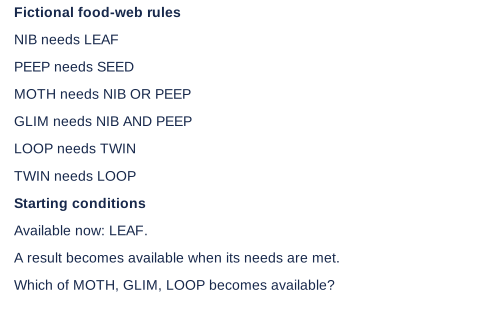
Use only the fictional food-web rules printed here. Start with the food available now. A creature becomes available when its food rule is met. Find which named visitor can live here; a loop cannot create its own first food.
Read this clue in text
Fictional food-web rules
NIB needs LEAF
PEEP needs SEED
MOTH needs NIB OR PEEP
GLIM needs NIB AND PEEP
LOOP needs TWIN
TWIN needs LOOP
Starting conditions
Available now: LEAF.
A result becomes available when its needs are met.
Which of MOTH, GLIM, LOOP becomes available?
Clue 2 of 6
Kit
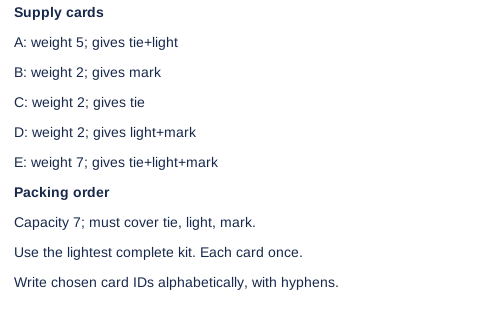
Pack a kit that supplies all three needs. One card may cover two needs, but its weight is counted once. Choose the lightest complete kit within the carrier limit. Report its card letters alphabetically.
Read this clue in text
Supply cards
A: weight 5; gives tie+light
B: weight 2; gives mark
C: weight 2; gives tie
D: weight 2; gives light+mark
E: weight 7; gives tie+light+mark
Packing order
Capacity 7; must cover tie, light, mark.
Use the lightest complete kit. Each card once.
Write chosen card IDs alphabetically, with hyphens.
Clue 3 of 6
Track
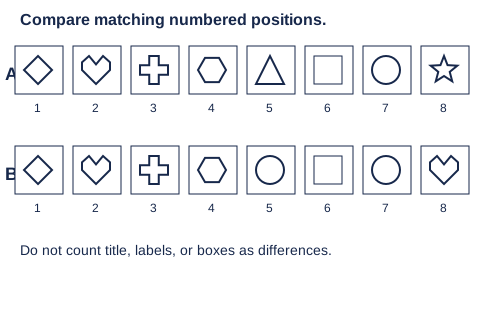
Track desk: Compare the two records at matching numbered positions. Count different pairs once each; ignore box outlines.
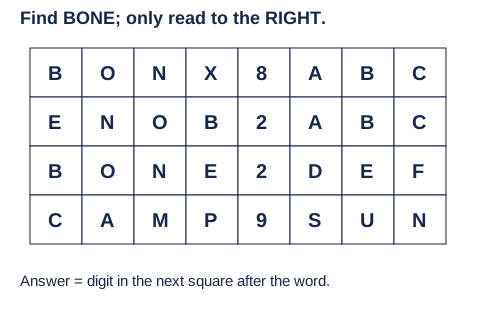
Label desk: Find the exact word BONE, reading RIGHT only. Reject near matches and reversed words. Copy the digit immediately after it.
Read this clue in text
Find BONE; only read to the RIGHT.
B
O
N
X
8
A
B
C
E
N
O
B
2
A
B
C
B
O
N
E
2
D
E
F
C
A
M
P
9
S
U
N
Answer = digit in the next square after the word.
Clue 5 of 6
Drawer
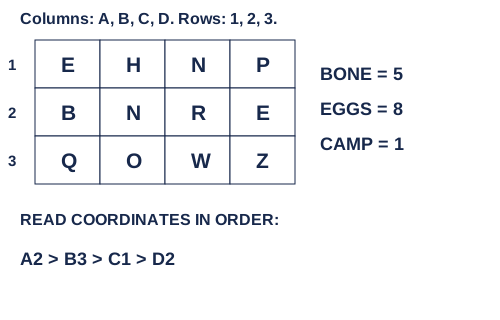
Drawer desk: Read the letter at each coordinate, in order. Letter = column; number = row. Convert the complete word using the printed table.
Read this clue in text
Columns: A, B, C, D. Rows: 1, 2, 3.
1
E
H
N
P
2
B
N
R
E
3
Q
O
W
Z
BONE = 5
EGGS = 8
CAMP = 1
READ COORDINATES IN ORDER:
A2 > B3 > C1 > D2
Clue 6 of 6
Final
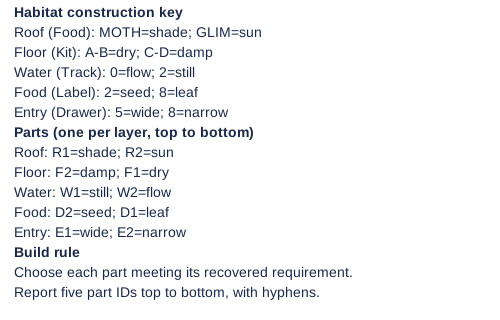
Recover one requirement for each habitat layer from its named result. Choose a matching roof, floor, water source, food and entry. Write the five part IDs in the printed layer order, then point to the evidence supporting each choice.
Read this clue in text
Habitat construction key
Roof (Food): MOTH=shade; GLIM=sun
Floor (Kit): A-B=dry; C-D=damp
Water (Track): 0=flow; 2=still
Food (Label): 2=seed; 8=leaf
Entry (Drawer): 5=wide; 8=narrow
Parts (one per layer, top to bottom)
Roof: R1=shade; R2=sun
Floor: F2=damp; F1=dry
Water: W1=still; W2=flow
Food: D2=seed; D1=leaf
Entry: E1=wide; E2=narrow
Build rule
Choose each part meeting its recovered requirement.
Report five part IDs top to bottom, with hyphens.
Start after: Food, Kit, Track, Label, Drawer
A different kind of mystery next
Keep the habit of sharing evidence and try a new reasoning task.